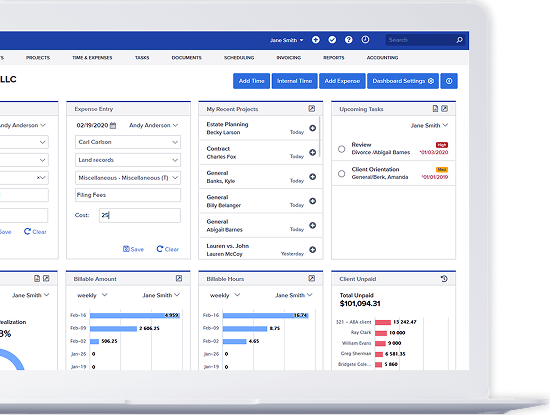
Time Management Software for Law Firms
07/20/2026 By Bill4Time Staff

For most attorneys, time is the one asset that’s impossible to get back once it’s spent and impossible to bill for once it’s forgotten. Lawyers who charge by the hour have to account for nearly every minute of their day, while lawyers on flat-fee or contingency arrangements still rely on accurate time entries to track case progress, staff workload, and profitability.
Yet keeping up with that level of detail by hand is nearly impossible. That’s why more firms are turning to legal time management software and specifically to legal time tracking software that captures hours automatically instead of relying on memory at the end of a long day.
Below, we’ll break down why time tracking matters, how lawyers actually keep track of billable hours, and what to look for in the best time management software for your firm.
Why Time Management Matters for Lawyers
Good time management isn’t just a productivity nice-to-have for attorneys—it’s tied directly to professional responsibility. The American Bar Association’s Model Rules of Professional Conduct, adopted in some form by most state bars, hold lawyers to real obligations around time:
- Rule 1.3 (Diligence) warns against procrastination, noting that a client’s interests can be harmed by unnecessary delay.
- Rule 1.4 (Communication) requires lawyers to keep clients reasonably informed and to respond promptly to requests for information.
Falling behind on time management doesn’t just create stress—it can expose a firm to real risk. Malpractice consultants regularly point to the same red flags:
- A disorganized office or filing system
- No consistent calendar
- No prioritized task list
- Sloppy or inconsistent timekeeping
And the financial cost adds up fast. A lawyer billing $100/hour who loses just six minutes a day to disorganization is looking at roughly $2,200 in lost billings a year. At a $200/hour rate, losing even 30 minutes a day can mean $22,000 in missed revenue annually for one attorney alone. Multiply that across a firm, and poor time management quickly becomes a profitability problem, not just an annoyance.
4 Benefits of Time Tracking Software for Lawyers
The good news: firms that adopt dedicated time tracking technology tend to see the impact almost immediately. Here’s what that looks like in practice.
1. Capturing Time That Would Otherwise Be Lost
Every phone call, email, and quick client question adds up—but only if it’s actually recorded. Time-tracking software captures those small increments in real time, rather than relying on an attorney to reconstruct their day from memory at 6 p.m. Firms consistently find “found” billable hours simply by switching from manual logs to automated tracking.
2. Increasing Productivity
Starting and stopping a timer as you move between matters is far more efficient than digging back through your calendar, inbox, and call log to reconstruct where your day went. Time management software lets attorneys track work as it happens—including from a mobile app while out of the office—so timesheets are accurate without the end-of-day scramble.
3. Streamlining Billing and Invoicing
Time entries are only useful if they turn into invoices clients can understand and pay promptly. The best legal time tracking software connects directly to your billing system, so tracked time converts into a client-ready invoice in just a few clicks. No re-entering data, no reconciling spreadsheets.
4. Giving Firms Better Oversight
Time tracking gives firm leadership visibility into where hours are actually going. Tracking both billable and non-billable time (administrative work, marketing, CLE, business development) helps firms spot low utilization rates, identify staffing gaps, and understand where automation could save real time.
How Do Lawyers Keep Track of Billable Hours?
Before time management software, lawyers tracked hours by hand—jotting notes throughout the day, then reconstructing timesheets from memory, paper calendars, and email trails. That process was slow, error-prone, and often meant billable time simply went unrecorded.
Modern timekeeping software for lawyers solves this with a few core capabilities:
- Real-time and passive tracking. The most effective approach is to track time as it happens rather than reconstruct it later. Some platforms go a step further with passive time tracking for lawyers, automatically detecting and logging activity like documents opened, calls placed, or time spent in a matter, so nothing falls through the cracks even when an attorney forgets to start a timer manually.
- Simple, non-discretionary tracking. When time tracking is optional or inconsistent, time gets missed. The firms that see the best results track all time, rather than deciding on a case-by-case basis what’s worth logging. This also reveals how much time is going toward non-billable work like administration or marketing, so nothing gets lost in the shuffle.
- Built-in billing. Time entries should flow directly into invoicing, so descriptions are clear, totals are accurate, and clients get bills they understand and pay faster.
Reporting and visibility. Firms need an easy way to see where time is actually going—by matter, by timekeeper, or by activity type—to spot inefficiencies and set realistic goals going forward.
What to Look for in Time Management Software for Law Firms
Not all time tracking tools are built for the realities of legal work. When evaluating options, look for a solution that offers:
- Accurate, low-effort time capture, including passive or automatic tracking so hours aren’t missed
- Mobile access to log time from anywhere, not just the office
- Seamless invoicing, so time entries become bills without manual re-entry
- Reporting that shows both billable and non-billable time across the firm
- Task management, so time entries stay connected to the right case
For firms that want to test the waters before committing, it’s also worth looking for free time management software for law firms—one with a trial period that lets you evaluate real-world time savings before making it part of your everyday workflow.
Give Bill4Time a Try
Bill4Time was built specifically to make time tracking simple for lawyers—combining time tracking, invoicing, contact and document management, and online payments in one place. Instead of losing minutes (and dollars) to manual timesheets, you can capture time as it happens and turn it into an invoice in a few clicks.
Try Bill4Time free for 14 days and see how much time and revenue your firm has been leaving on the table.