Why Time Tracking Is Becoming a Strategic Metric for Law Firms
01/29/2026 By Clare Sheehan

Time tracking has long carried an unfortunate reputation. It is seen as tedious, disruptive, and something to be done later, often at the end of a long day or worse, at the end of the week. Historically, its purpose was narrow: record billable hours, generate invoices, and support collections. That perspective no longer reflects how high-performing firms operate.
Today, time tracking is becoming one of the most influential operational metrics in legal practice. When you examine not just how much time is billed, but how time is spent, captured, delayed, or written off, you unlock insights that shape profitability, staffing decisions, pricing strategy, and client trust.
Firms that analyze time data holistically consistently outperform those that treat it as a compliance exercise. The difference lies in recognizing time as a strategic asset rather than an administrative obligation. This shift is central to the ideas explored in Bill4Time’s companion white paper, Emerging Trends in Legal Billing. If your firm is evaluating its billing framework, start with time data.
The Evolution of Time Tracking in the Legal Industry
Time tracking has always been foundational to the legal business model. Hourly billing required firms to document work performed, and time entries became the currency of revenue. But for decades, time data lived in isolation. It was recorded, billed, and archived, rarely examined beyond invoice review or month-end reports. The focus was on compliance, not insight. That model is changing. As firms face margin pressure, rising client expectations, and increasing competition, leadership teams are rethinking what time data can reveal. Every time entry tells a story about efficiency, workflow design, staffing alignment, and client value. When aggregated and analyzed, those stories become patterns you can act on. Industry research consistently shows that firms with disciplined, timely time capture uncover meaningful gaps. Whether it is underreported billable work, uneven workloads, or practice areas consuming disproportionate non-billable hours, precise time data exposes opportunities that were previously invisible. Time tracking is no longer just a record of the past. It is a lens into how your firm actually operates.
The Hidden Value Within Time Data
Accurate time tracking gives you operational visibility that few other metrics can match. When you analyze time data across matters, clients, and practice areas, you begin to see where work slows down, where resources are stretched thin, and where revenue leaks occur. Many firms are surprised by what they uncover. Common patterns include:
- Significant attorney time absorbed by administrative work
- Certain matters consistently exceeding estimated effort
- Uneven distribution of work across teams or seniority levels
- Underutilized staff alongside overextended partners
These insights are not theoretical. Firms that review time capture trends often identify meaningful gaps between recorded and actual work performed, along with workload imbalances that contribute to burnout and attrition. The real value of time tracking is not in collecting entries. It is in interpreting what those entries reveal and using that information to rebalance workloads, forecast staffing needs, and prioritize the work that drives profitability.
How Accurate Time Tracking Drives Profitability
Incomplete or delayed time entries have a direct financial impact. When time is reconstructed from memory days later, details are lost. Billable work goes unrecorded, descriptions become vague, and realization rates suffer. Over time, these small gaps compound into significant revenue loss. Accurate, timely time capture allows you to calculate the true cost of missed entries and understand how much revenue quietly slips through the cracks each month. It also improves forecasting by giving you a reliable view of work in progress and expected billing. Equally important is tracking non-billable time. When you understand where internal hours are being consumed, you can identify process inefficiencies, eliminate redundant work, and redirect effort toward higher-value activities. Utilization, realization, and collections all depend on accurate time data. Without it, financial performance metrics lose their reliability and decision-making becomes reactive rather than informed.
Turning Time Tracking Into Strategic Insight
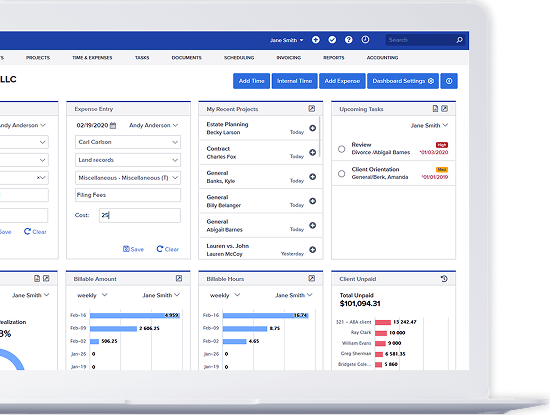
Time tracking becomes strategic when it moves beyond raw totals and into analysis. Leading firms rely on visual reporting and real-time dashboards to spot trends as they develop. Matter-level insights reveal which engagements are truly profitable and which erode margins. Client-level analysis highlights where pricing aligns with effort and where adjustments are needed. Time data also supports smarter forecasting and pricing strategies. By understanding historical effort patterns, you can more confidently offer fixed or hybrid fees, anticipate demand, and staff matters appropriately. Some firms use time insights to identify training gaps, refine staffing models, or adjust leverage across practice areas. Others use it to proactively address capacity constraints before they impact service quality. The most competitive firms do not wait for monthly reports. They continuously analyze time-series data to inform real-time decisions. For example, using Bill4Time’s legal reporting software, firms can transform their data into actionable insights. Bill4Time reporting is exceptionally flexible and allows firms to create highly customized reports organized by date range, user, matter, or activity to surface the exact data needed at any given moment.
Time Tracking as a Driver of Client Trust and Transparency
Clients expect clarity. They want to understand what they are paying for, how work is performed, and how fees align with value. Detailed, accurate time records support transparent billing and reinforce confidence in your firm. When you can clearly articulate how time was spent and why it mattered, billing conversations become easier, and disputes decrease. Time transparency also strengthens pricing alignment. Firms that understand their effort at a granular level are better positioned to set realistic expectations, avoid surprise overruns, and justify fees with confidence. In this way, time tracking becomes a trust metric. It demonstrates accountability, professionalism, and respect for the client relationship.
The New Productivity Equation: Time + Insight + Action
Strategic time tracking follows a simple but powerful loop: Track → Analyze → Optimize → Repeat When you consistently review time data, it becomes a foundation for continuous improvement. You can set clearer goals, align performance reviews with measurable outcomes, and ensure firm-wide focus on what drives results. Common KPIs include:
- Time capture rate
- Average delay between work performed and entry
- Percentage of non-billable hours
- Profitability per matter or client
When these metrics are reviewed regularly, time tracking evolves from a task into a shared language for operational and financial planning.
How Bill4Time Supports Strategic Time Tracking
Firms gain the most value from time tracking when it is simple, consistent, and aligned with broader operational goals. When time is captured naturally within daily workflows, accuracy improves, and insights become more reliable. Bill4Time supports firms that want to move beyond basic billing and use time data to inform smarter decisions, stronger client relationships, and sustainable growth. If you are ready to rethink how your firm uses time data, start by evaluating your billing framework.